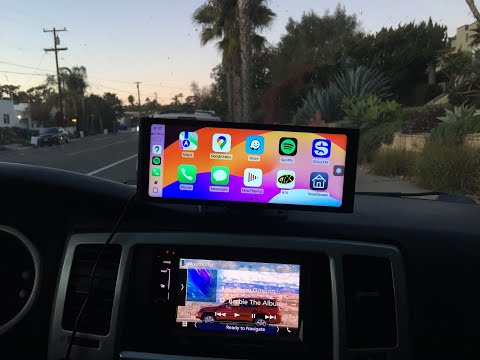
Does the HAUXIY 9" screen work with both iPhone and Android phones?
It supports wireless Apple CarPlay for iPhones and wireless Android Auto for Android phones through the same unit, connecting via Bluetooth and WiFi rather than a USB cable. Pairing is quick, and the unit can reconnect automatically on later drives. Which platform you get access to depends on which phone you connect - it does not run both simultaneously.
Is the backup camera easy to install?
Not entirely plug-and-play. Hooking up the camera may require drilling into the trunk and tapping into the backup light wiring, which can leave the camera unconnected.
Does the screen stay mounted securely on the dashboard?
Installation is generally easy, though the included mount may not stay on the dash, in which case a separate windshield suction mount can be used instead. Test-fitting the included mounts before committing to a permanent position is worth doing.
Will this work without a phone connected?
CarPlay, Android Auto, navigation, calling and voice control all route through a connected smartphone's apps and data connection, so the screen has no independent navigation or app functionality of its own. If the phone loses signal or isn't connected, those features stop working. The FM radio and AUX audio paths are the exceptions, since they don't depend on a paired phone.
Does it keep the original car stereo working?
Yes, the manufacturer designs the unit to sit on the dashboard via a cigarette-lighter power connection and mount, rather than replacing the factory radio, so the original stereo remains in place and usable. This also means installation does not require removing the center console. Audio from the new screen reaches the car's speakers separately, through Bluetooth, the unit's own speakers, FM or AUX.
Will it keep working if Apple or Google updates CarPlay/Android Auto?
The unit is built with over-the-air firmware updates specifically to maintain compatibility as CarPlay and Android Auto are revised, pushing new system updates automatically. This is meant to avoid the common problem of aftermarket screens losing pairing reliability after a phone OS update. Feedback so far focuses on initial setup rather than long-term update performance, so how well this holds up after a year or two of phone software changes is not yet established.