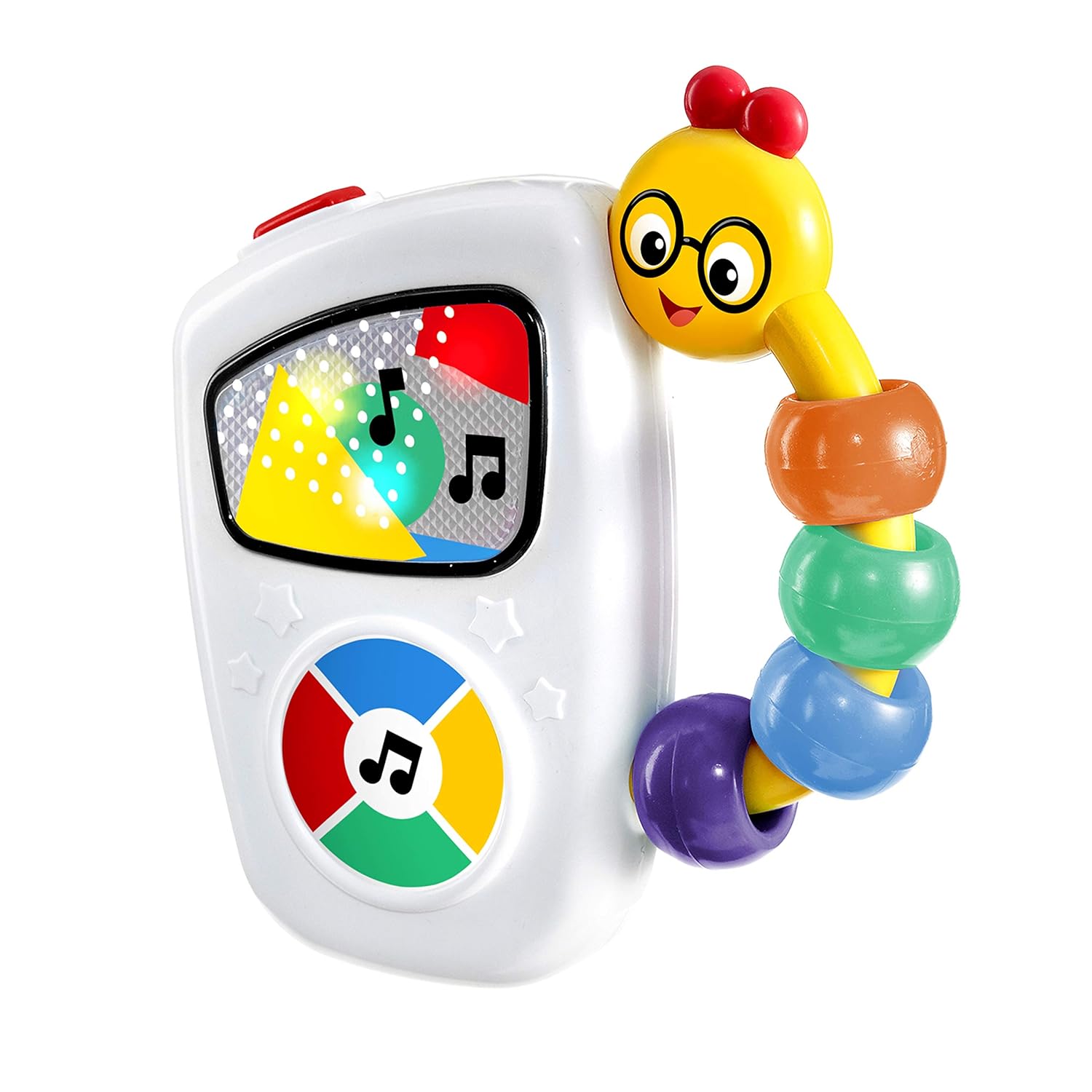
What age is it actually for? Baby Einstein's own materials give three different answers.
Baby Einstein states the recommended age in three places and they do not agree: the product title says 3 months and up, one age range says 6 to 36 months, and the manufacturer's recommended age says 3 months to 3 years. The most likely reading is that the toy is designed for roughly three months to three years, with the six-month figure a more conservative entry, and it suits babies and toddlers alike. In practice the age question answers itself by capability: at three months a baby responds to the music while an adult presses the button; from around four to six months they start hitting it themselves; and it stays in use well into toddlerhood as a portable, familiar object.
It arrived quiet or dim out of the box. Is it faulty?
Check the batteries before assuming so. Baby Einstein is unusually straightforward about this: two AA cells are included for demo purposes only, and the instructions say to use new batteries for regular use. Demo cells shipped in a toy are frequently close to exhausted, so a toy that seems quiet, dim or intermittent on arrival is usually reporting flat batteries rather than a fault. Put fresh ones in before deciding anything, and before giving it as a gift.
Is the battery compartment safe for a baby to be around?
It should be secured with a screw so a child cannot open it, and this is worth checking rather than assuming, since AA cells are both a choking and a chemical hazard if reached. Check the screw is present and tight when the toy arrives and again whenever you change the batteries, inspect the casing periodically for cracks, and retire the toy if the compartment ever stops closing securely. Supervised play is the standing advice at this age regardless of the toy.
Can my baby operate it themselves, or do I have to press it for them?
At three months, you press it for them and they respond to the music and lights. Somewhere between four and six months most babies start hitting the button themselves, which is when the cause-and-effect learning genuinely begins: press, something happens, press again, the same thing happens. The large, palm-operable button is designed for this transition: a small button would demand precision an infant does not yet have and produce frustration rather than learning.
Can I wash it?
No, it is wipe-clean rather than washable or submersible. Use a damp cloth rather than running it under a tap or putting it in a dishwasher, and check the battery compartment stays sealed while cleaning. Given that everything a baby handles ends up in their mouth, wiping it down regularly is worth doing even though full washing is not possible.
Will the melodies get annoying after months of use?
Less than most toys, by design. The pieces are classical rather than nursery jingles, drawn from Chopin, Mozart and others, and melodically richer music wears better on repeated listening than a synthesised rhyme. Combined with the volume control, this is why the music tends to stay soothing rather than annoying, which is unusual for a children's toy.