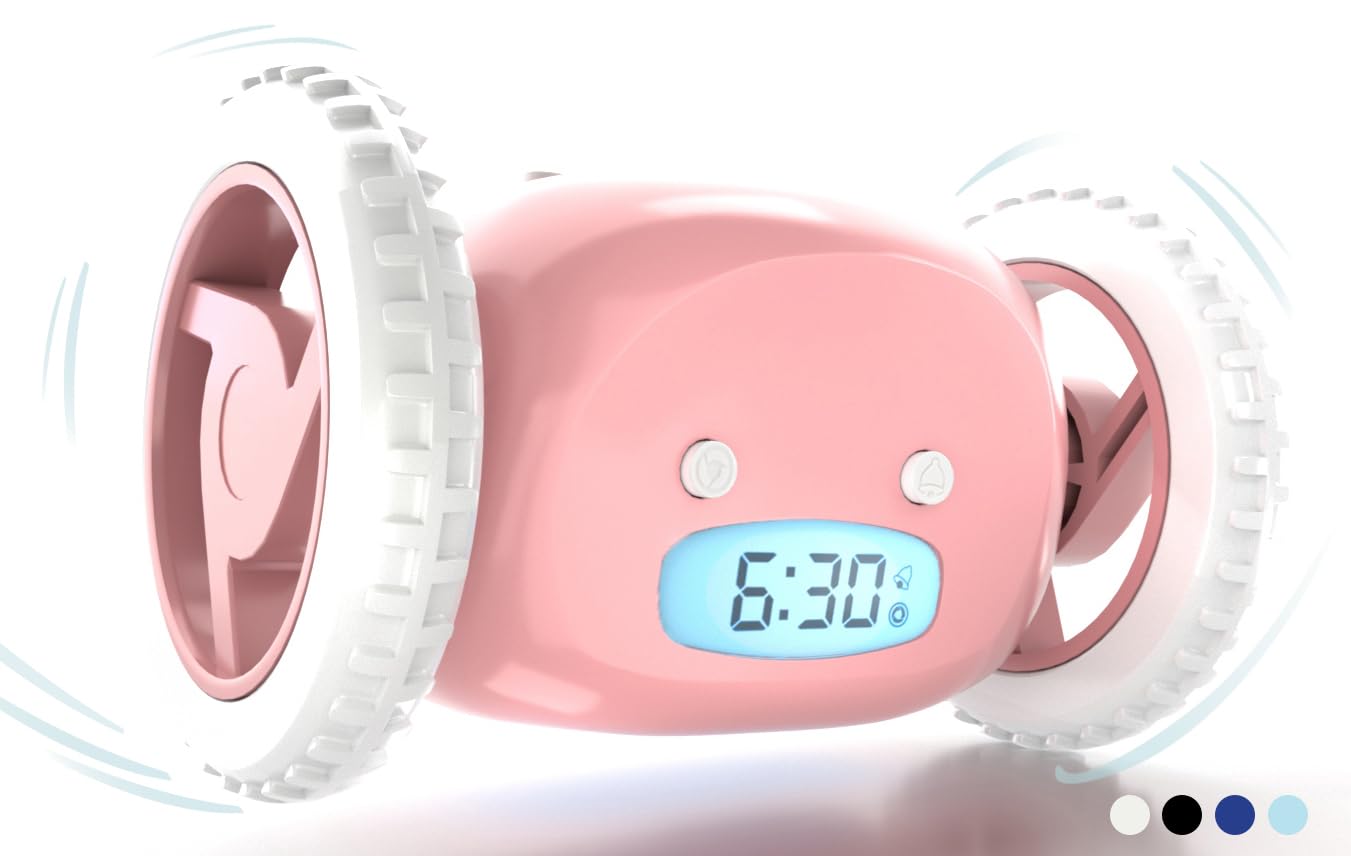
Will it actually run away on carpet?
The floor decides, and that is the difference between a clock that works and a gimmick that sits there beeping. Small wheels under a light plastic body need traction and clearance. Hard floors, thin carpet and low rugs give it the best chance to roll the way it is meant to, while deep pile can bog it down. Clutter counts just as much: it can get stuck when it bumps into something, and shoes, cables or a laundry pile will pin it close to where it lands. Clear a path before you rely on it.
Will it survive the drop off my nightstand?
Jumping off the nightstand is what it is built to do, and at 0.3 kg there is very little mass to throw at the floor, which is why it usually lands and drives off. That is not a licence to launch it from a high shelf onto tiles every morning. The sensible setup is ordinary bedside height, a landing zone with no furniture legs or step down, and nothing breakable in the way. The build is generally good, though it remains a plastic shell on wheels rather than a toughened device, and a rattle after a hard landing has been reported.
Can I stop it running and use it as a normal alarm clock?
Yes, and that is one of the best things about it. The wheels are switched separately from the alarm, so you can leave it parked on the nightstand and it behaves like an ordinary loud digital alarm. That matters on days off, when a partner is still asleep, or for a child who is not ready for the full chase. It is worth checking the wheel setting before bed, because assuming the wheels are on is exactly how people end up sleeping in.
Is it loud enough for a genuinely heavy sleeper?
Opinion divides here and it is worth being straight about it. CLOCKY builds this around volume plus movement rather than volume alone, and for most people the combination works, because the waking comes from having to get up and chase it rather than from the sound itself. The alarm is often very loud, with a restless robot-like tone that is hard to ignore, but some will expect more. If you routinely sleep through a phone alarm at full volume, the running is the feature you are buying. Treat the noise as a prompt, not the whole plan.
Why does the alarm go off at odd times, or the snooze misbehave?
These are the two most common gripes. Some of it comes down to how the snooze is meant to work: you choose one snooze or none, so it is not a button to lean on repeatedly, and snoozing means the clock runs again when the alarm returns. For alarms at odd hours, start with setup: reset the clock time, check the alarm time is exactly what you intended, and prove it with a test a few minutes ahead while you are awake. If it still sounds when it should not, that points to a fault worth raising under the limited warranty.
What batteries does it take, and can I read the time in the dark?
Four AAA batteries, and quality matters more than usual here, because driving a motor and wheels across a floor asks more of them than simply keeping time. Weak batteries are the first thing to suspect if the clock starts to struggle. On the display, it is not permanently lit. For anyone who wants a glanceable bedside clock, this is the main frustration, since checking the time at night means pressing a button rather than just looking.