Does it set itself, and will the time stay accurate?
Abovsare includes Auto DST, and it pays to be precise about what that covers: the clock holds the calendar rule for daylight saving and shifts itself on the right weekend. It does not correct the time against an outside reference: you set the time yourself from the remote, and once set it keeps accurate time in daily use. Abovsare flags one quirk worth knowing. Every press of the Set button resets the seconds to zero, so pressing it again after the time is right makes the clock look slow. Set it once against your phone, and set the correct year too, or the day of the week will not match.
Does it have to stay plugged in, and what are the batteries for?
Yes. It runs from a USB connection, because a display this size needs continuous power rather than cells. Batteries in the battery box power what Abovsare calls a memory function, which holds the time data through a disconnection so nothing has to be re-entered when the power comes back. They will not keep the display lit if you unplug it. The practical consequence is that the clock lives wherever a cord can reach it.
Is it too bright for a bedroom at night?
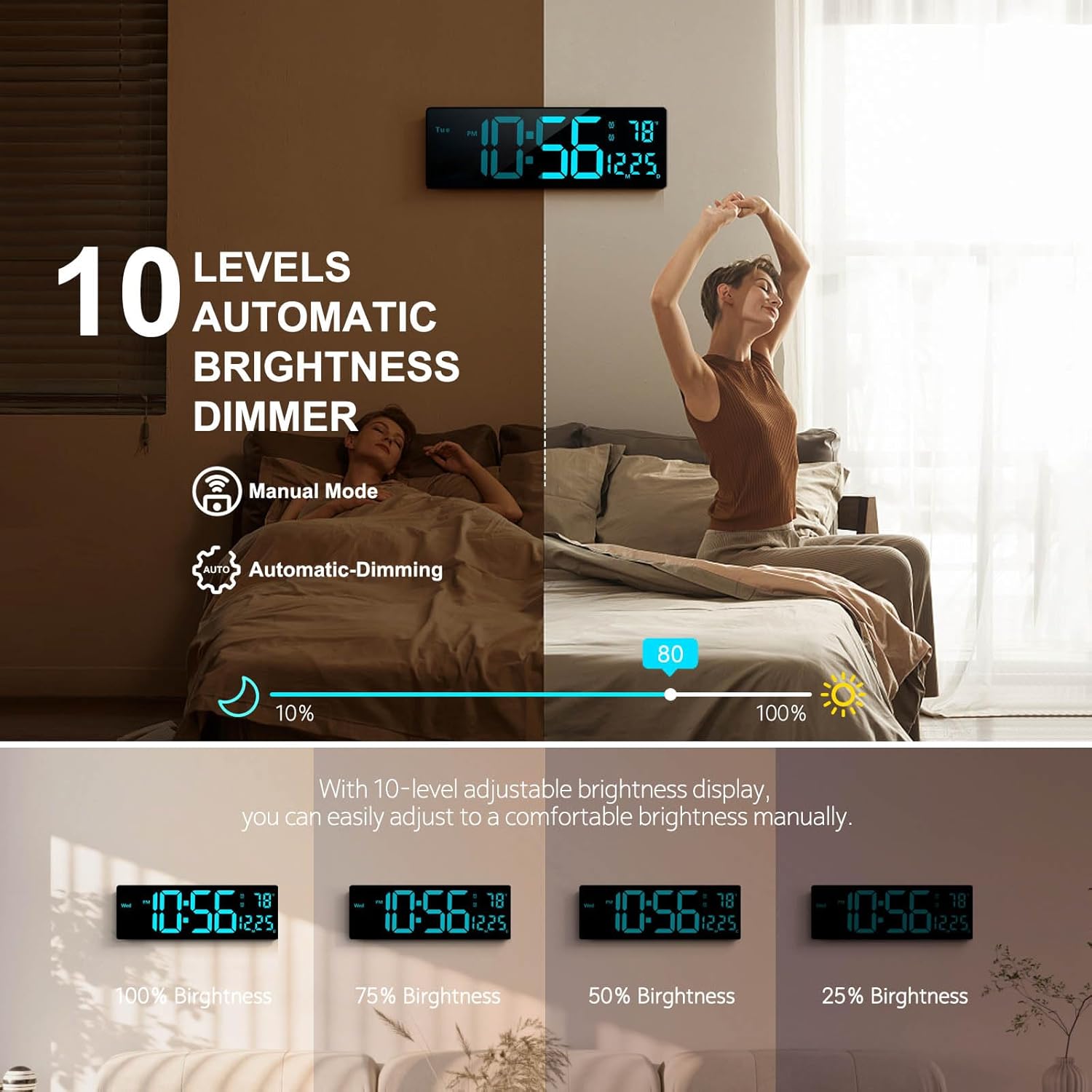
Not if you use what is built in. Abovsare gives the display ten brightness levels and an automatic dimming sensor, plus a nine-colour ambient light at the base that can be switched off, so a screen sized for a classroom can be dialled down to something you can sleep beside; turning it down at bedtime and back up in the morning is all it takes. The catch is that every setting goes through the remote. Colour, brightness, alarm and time are all adjusted from it, so give the remote a fixed home. Losing it turns a simple clock into an awkward one.
Will it really be readable from across a room?
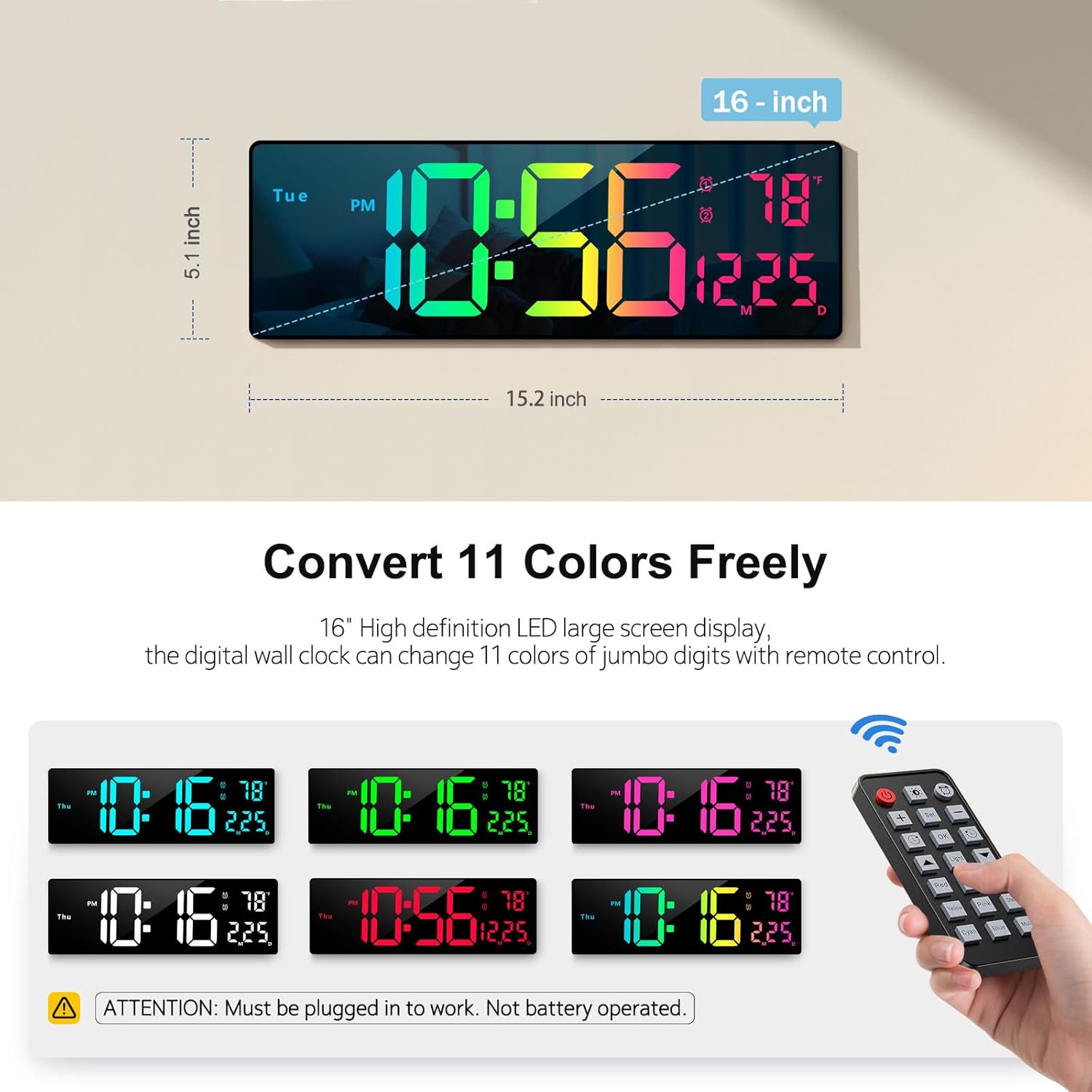
Yes, and that is its greatest strength, in classrooms as well as homes. Abovsare rates the screen at 16 inches with the body itself 15 inches wide and 5 inches tall, so almost the whole face is digits rather than frame. That is a different proposition from a bedside clock scaled up: it reads clearly from anywhere in the room without squinting, and it carries date, day and temperature alongside the time. For failing eyesight, it is the right shape of product.
How does it mount, and where does the cord end up?
Both ways are supported. Abovsare designs it for wall mounting or standing on a surface, and at roughly 1.2 pounds in a plastic housing a wall fixing needs little more than a nail and a hammer. Power is the real constraint. A corded clock has to sit within reach of an outlet, and a cable running down a feature wall undoes the look. Pick the spot by where the socket is rather than the other way round; a shelf, bookcase top or media unit is often tidier than a wall for precisely that reason.
How accurate is the temperature reading?
Treat it as a comfortable indication rather than an instrument. A sensor housed in a plastic case with a large illuminated display beside it reads the air around that case, and LEDs and electronics give off some heat, which can nudge a built-in sensor warm. Placement matters too. Above a radiator, in afternoon sun, or high on a wall where warm air collects, it can differ from a thermometer at seated height, so keep it away from heat sources if the reading matters to you.