Is a premium toaster like this actually worth it?
Buyers are genuinely split on value for money. Several who had replaced cheap toasters repeatedly conclude the cost buys real long-term repairability and durability, while others, including owners who love the toaster, feel it is overpriced. It comes down to whether you would rather repair one toaster for years than replace cheaper ones as they fail.
What does 'replaceable ProHeat elements' actually mean for me?
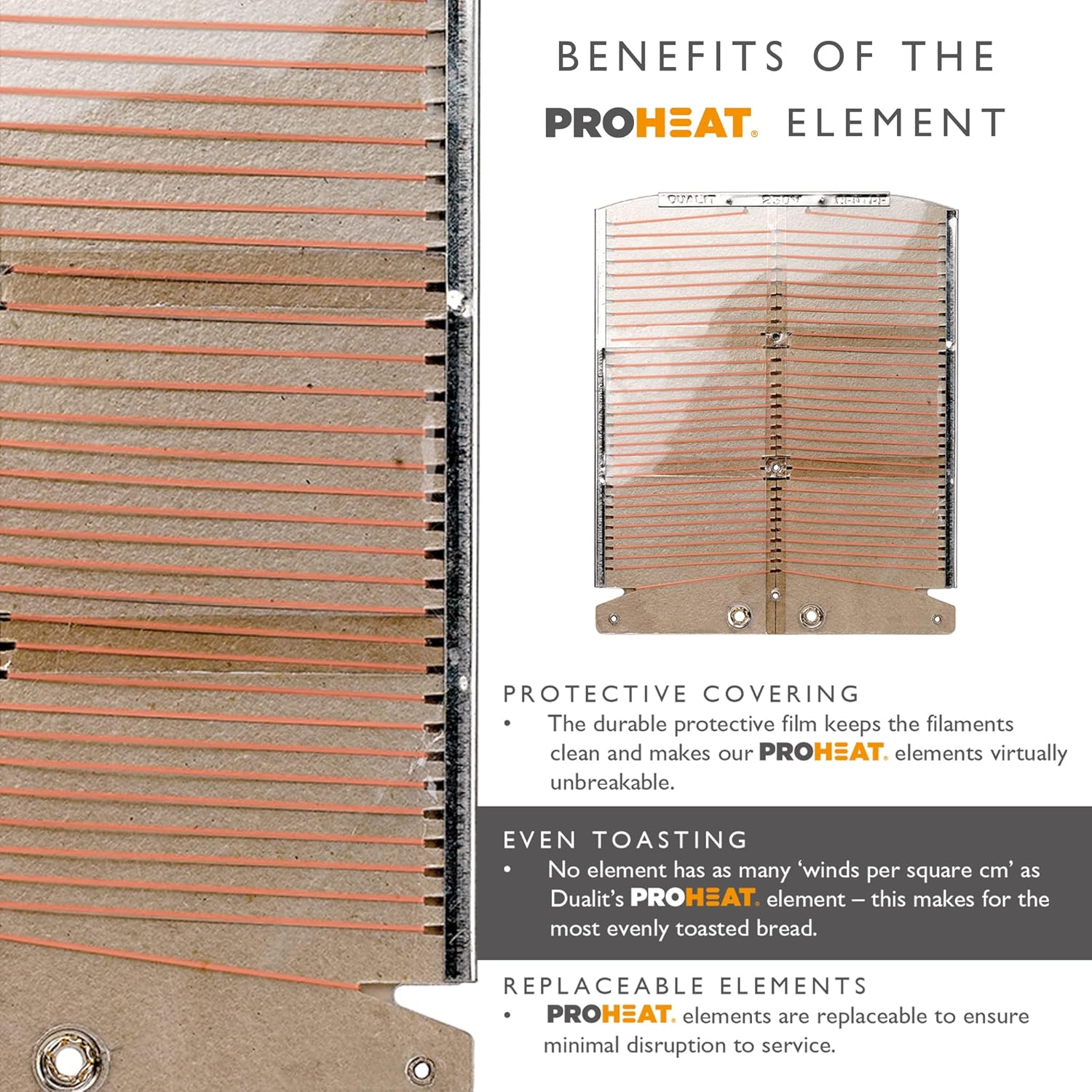
It means that if the heating element eventually fails, Dualit's design allows that specific part to be replaced rather than requiring you to discard and replace the entire toaster. Dualit gives these elements a protective, armour-plated layer that it says makes them virtually unbreakable.
Is this a fully automatic toaster, or manual?
It's manual and mechanically controlled, using a timer dial and an ejector lever rather than an automatic push-down mechanism. One owner notes that if you prefer fully automatic operation, this style of toaster isn't the right fit - it's aimed at buyers who prefer active, manual control.
How wide are the toast slots? Will it fit bagels and thick bread?
Dualit describes the two slots as extra-wide at 28 mm, wide enough to take its sandwich cage. There is a bagel function that toasts one side while warming the other, and the ejector lever lets you lift and check bread mid-toast, which Dualit suggests for crumpets, tea cakes and bagels, along with a dedicated defrost setting for frozen bread.
Is it made of aluminum or stainless steel?
Stainless steel, in a Metallic Charcoal finish, and the whole toaster weighs 7 pounds.
Does the toast pop up on its own when it's done?
No. Dualit's ejector system keeps the toast down in the slots, where it stays warm, until you push the lever up. Owners who like manual control see that as an advantage, since the toast is still warm whenever they get to it, but if you want a toaster that pops up by itself, this is the wrong style.