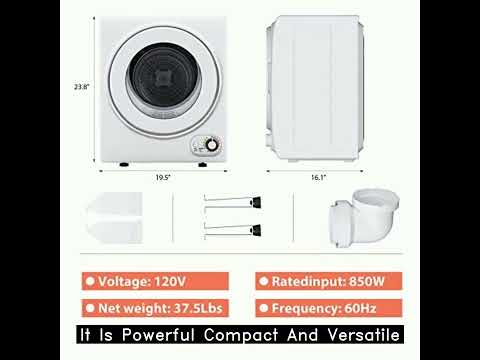
Do I have to vent it out of a window?
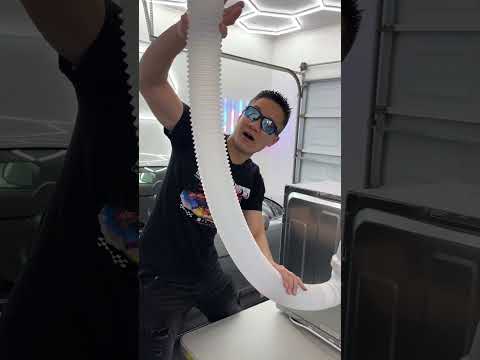
Yes, and that single fact decides where this dryer can live. It is a vented design, not a condenser: the drum pulls in room air, heats it, and pushes hot damp air out through the plastic hose Panda supplies in the box. The moisture has to go somewhere. Send it out of a window or through an existing dryer port. An indoor vent kit is possible, but it can push room humidity from 30 to 50 percent, tolerable in a dry winter but not something to live with all year. Keep the hose short and straight, with no sag holding water.
Does it need a special outlet or its own circuit?
No, and that is the whole point of it. The 850W motor and heater run on ordinary 110V household power through a regular three-prong plug, which is why a dryer like this works in a dorm room or a rental with no laundry hookup. Plug it straight into a wall socket rather than a power strip or a thin extension lead, because heating appliances draw steadily for the entire cycle rather than in bursts. If the same circuit already feeds a space heater, kettle or microwave, run them at different times. Breakers trip on the total load, not on any one appliance.
How much laundry actually fits in 1.5 cubic feet?
Treat it as a load for one or two people, not a family wash. Panda rates it for up to 10 pounds of wet laundry, and a load typically finishes in about 80 minutes. With a 1.6 cu.ft portable washer, half a washer load is the practical limit, or roughly seven light garments or three pairs of jeans. Tumbling needs air: garments have to fall and separate to dry, so a drum packed to the door comes out damp however long it runs. Bulky items, a duvet cover or several large bath towels, sit outside what this machine handles in one go.
Why are my clothes still damp when the cycle ends?
Drying time is the most variable part, and the usual causes sit outside the machine. Start with the wash, since clothes that were not spun hard carry far more water in and a vented dryer has to evaporate every drop of it; Panda itself recommends spinning before drying. Then reduce the load size. Then check the hose for kinks, crushes or an unnecessarily long run, because restricted airflow traps the moisture the dryer is trying to expel. Clear the three-layer filter. Finally, use the hot zone of the timer with high heat, and allow for the heat taking several minutes to build at the start of a run.
Can I wall-mount it or stack it over a washer?
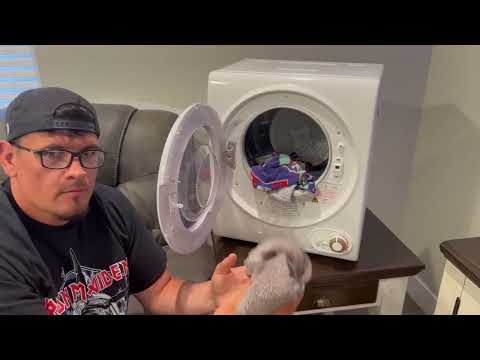
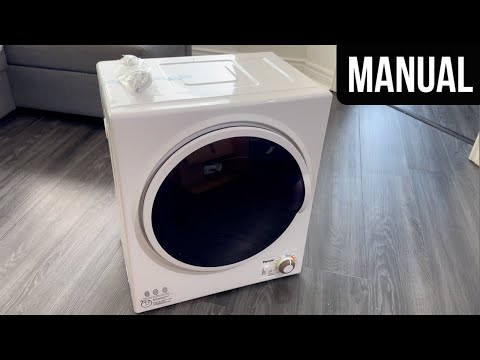
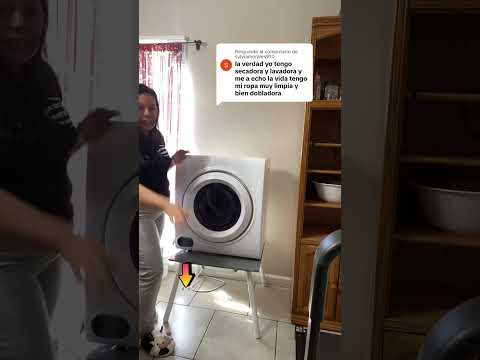
Yes. Panda sells it for freestanding, stacked or wall-mounted use, includes a wall-mount kit, and the machine is light enough for one person to lift, at a shade under forty pounds. That does not make any wall suitable. Panda's own advice is to fix a length of lumber to the wall first and mount the dryer on that, and a tumbling drum shifts weight constantly, so the lumber belongs on studs or in proper masonry anchors, never in plasterboard alone. Mount it level, leave clearance behind for the hose to leave without bending sharply, and keep the door swing free: the see-through door opens to 105 degrees and wants space in front of it.
How loud is it, and how hot does it get?
Both are a mixed picture. It can be quiet enough to almost fall asleep to, though the steady hum of the motor and fan is noticeable. Panda caps the drum at 140°F, and the exhaust air and cabinet get warm as any vented dryer does; it tends to warm a small living space noticeably only when the oven is also on. Stand it on a solid, level base to keep rattles down, and use the cold or air dry mode for anything heat sensitive. If a scraping noise appears after months of use, the likely cause is the worn drum felt rather than a failing motor.