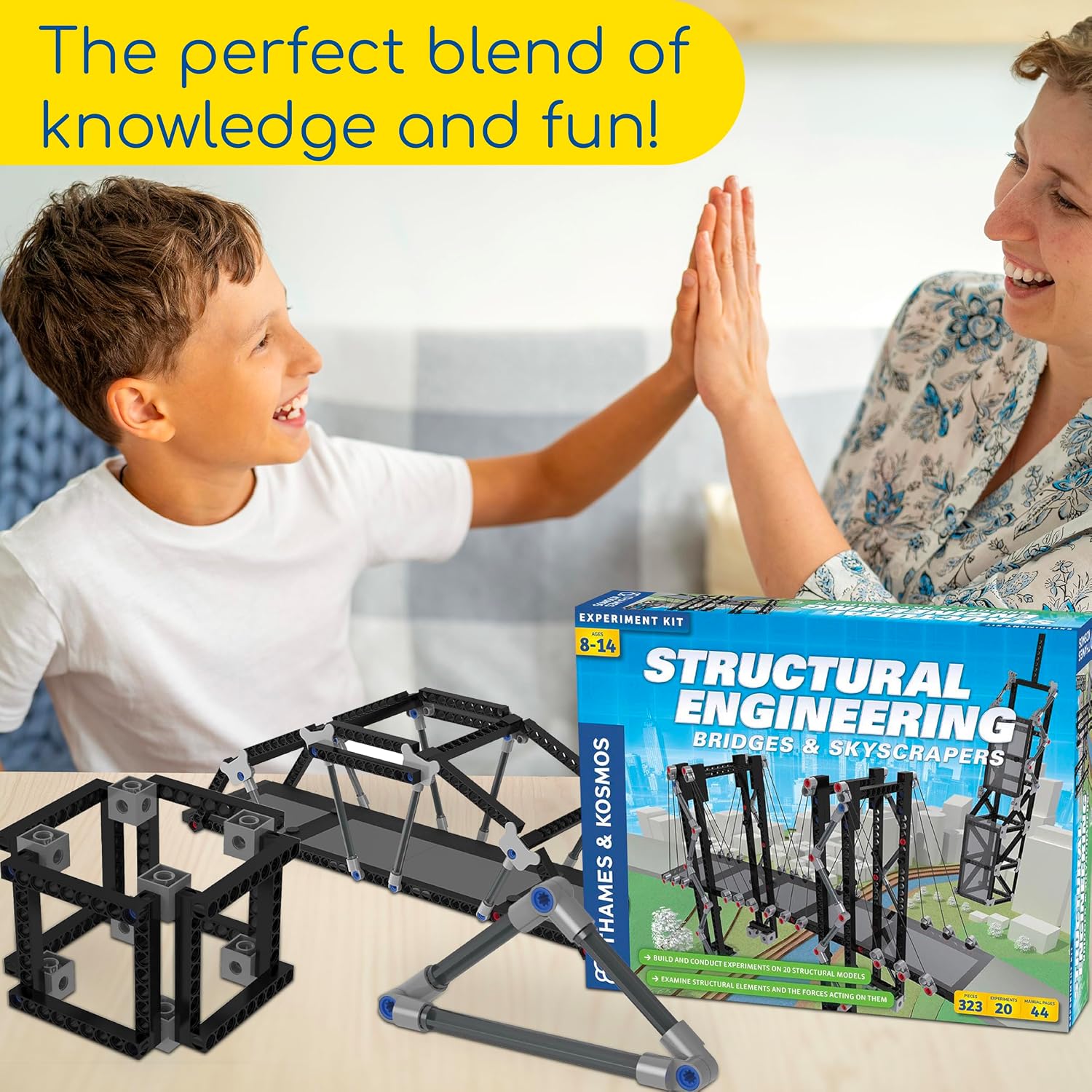
What does a child actually learn, beyond stacking pieces?
More than most construction sets teach, because each of the 20 models is anchored to a principle rather than just a shape. Thames & Kosmos builds the kit around force, load, compression and tension. Those are the ideas that explain why an arch pushes its load outward into its supports while a suspension span hangs its deck from cables held taut. Pressing gently on a finished bridge shows a child which members are being squashed and which are being stretched far faster than a diagram does.
Is eight really the right starting age?
Thames & Kosmos rates it 8 to 14 and calls the skill level intermediate, and both are honest. The bottom of that range works best with an adult nearby, because the builds involve reading illustrated plans, telling near-identical parts apart and undoing mistakes without giving up. An older child in the range will work through it alone and get the most from it. Below eight, the piece count and the care needed to join and separate parts turn it into a parent's project with a child watching, which is not what you are buying it for.
Are the instructions clear enough to build unaided?
Mostly, yes. Where they fall short, it is not that steps are wrong but that some lack relevant detail. With picture-led instructions it is easy to get a few steps further before realising a strut went in the wrong way round. Work in good light, lay parts out by type before starting, and check the build against the illustration at every stage instead of only at the end. Most frustration with kits of this kind traces back to that habit.
How fragile are the pieces?
Fragile enough to plan for: reliability is the kit's clearest weakness. The parts are plastic, and plastic pieces that grip by friction wear at the joint every time they are forced in or twisted out, which is the standard failure mode for this whole category rather than a surprise here. The yellow tools supplied for separating pieces can also be poor at gripping. The practical answer is technique: press pieces straight in instead of levering them at an angle, pull them straight out, and teach a child to stop and reposition rather than force a part that will not seat.
Can models stay built, or does everything get dismantled?
With 287 pieces shared across 20 designs, you build one substantial structure or a couple of small ones at a time and then take it apart to make the next. That is normal for the format but worth saying out loud, because a child who wants to keep a finished bridge on a shelf will be disappointed. It also means the repeated assembly and disassembly that stresses the joints is unavoidable, since rebuilding is the whole point. A shallow lidded box for sorting parts by type between projects saves a lot of hunting and a lot of arguing.
Who is this a good gift for, and who should skip it?
It suits a child who already enjoys building and will sit with a manual. It lands well as a gift for a budding engineer, and children genuinely enjoy working through the models. Thames & Kosmos backs it for a year against manufacturer defects. Skip it if you want something that shrugs off rough play, something a much younger sibling can join in with, or anything motorised, because the box holds plastic building pieces and an illustrated manual and nothing else.