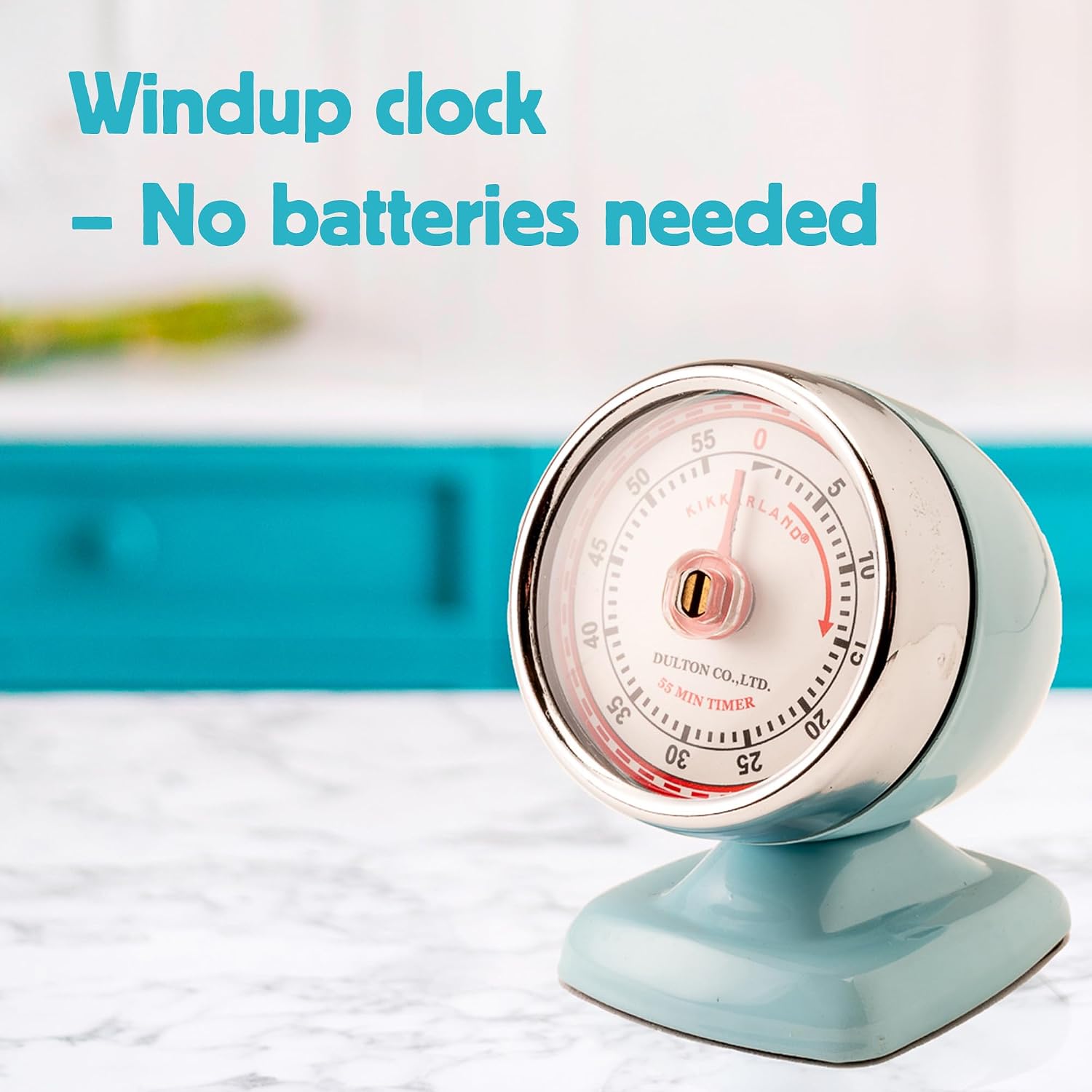
How long can the Kikkerland Vintage Streamline Timer run before it needs rewinding?
Kikkerland caps its useful range at up to 55 minutes per wind. Turning the dial clockwise all the way, then back to the desired setting, stores mechanical energy that unwinds until it reaches zero and triggers the bell. That ceiling means it isn't built for tasks running longer than about an hour without a second wind partway through, so it suits short kitchen or desk tasks rather than long, unattended ones.
What is the timer made of, and how much does it weigh?
The housing is steel, finished in red with a chrome-ringed dial, and the whole unit weighs 6.4 ounces. Its footprint is 2.25 inches deep by 3 inches wide by 3.25 inches tall, with a 3.25-inch dial face. That combination gives it noticeable heft for its size, and it feels more substantial than a typical plastic kitchen timer: solid metal with real weight to it rather than something that feels hollow or cheap on a countertop.
Does this timer need batteries?
No. It's a fully mechanical, spring-wound design, and Kikkerland confirms it needs no batteries at all. Winding it clockwise to the end and setting it to the desired time powers both the ticking movement and the bell. That also means there's no battery compartment to corrode or need replacing, though the mechanism itself is the one moving part that can wear out over time, and its long-term reliability is mixed rather than guaranteed.
Is this timer reliable in the long run?
The evidence here is genuinely mixed. Reliability is mixed and durability is the weak point. Units have stopped ticking after about three months, and alarm bells have gone silent around the one-year mark, but others hold up for several years and still work every time. Weigh that spread honestly rather than assume either outcome.
How loud is the alarm, and is the dial easy to read?
Both divide opinion. The alarm is a small mechanical bell rather than a digital speaker, and it can ring very loudly, which is reassuring in a busy kitchen but too much for some households. The dial face is 3.25 inches across on a compact 2.25 by 3 by 3.25 inch case, so the markings can feel tight to set precisely. Which experience you get isn't something the specifications alone can predict.
Does the retro design reflect good value for the price?
Value for money divides opinion: it depends on whether the retro design and solid metal build justify the cost compared with a basic plastic kitchen timer. Buyers who care most about the look and feel tend to be satisfied, while those focused purely on functional timing may find a simpler, cheaper timer does the same job.