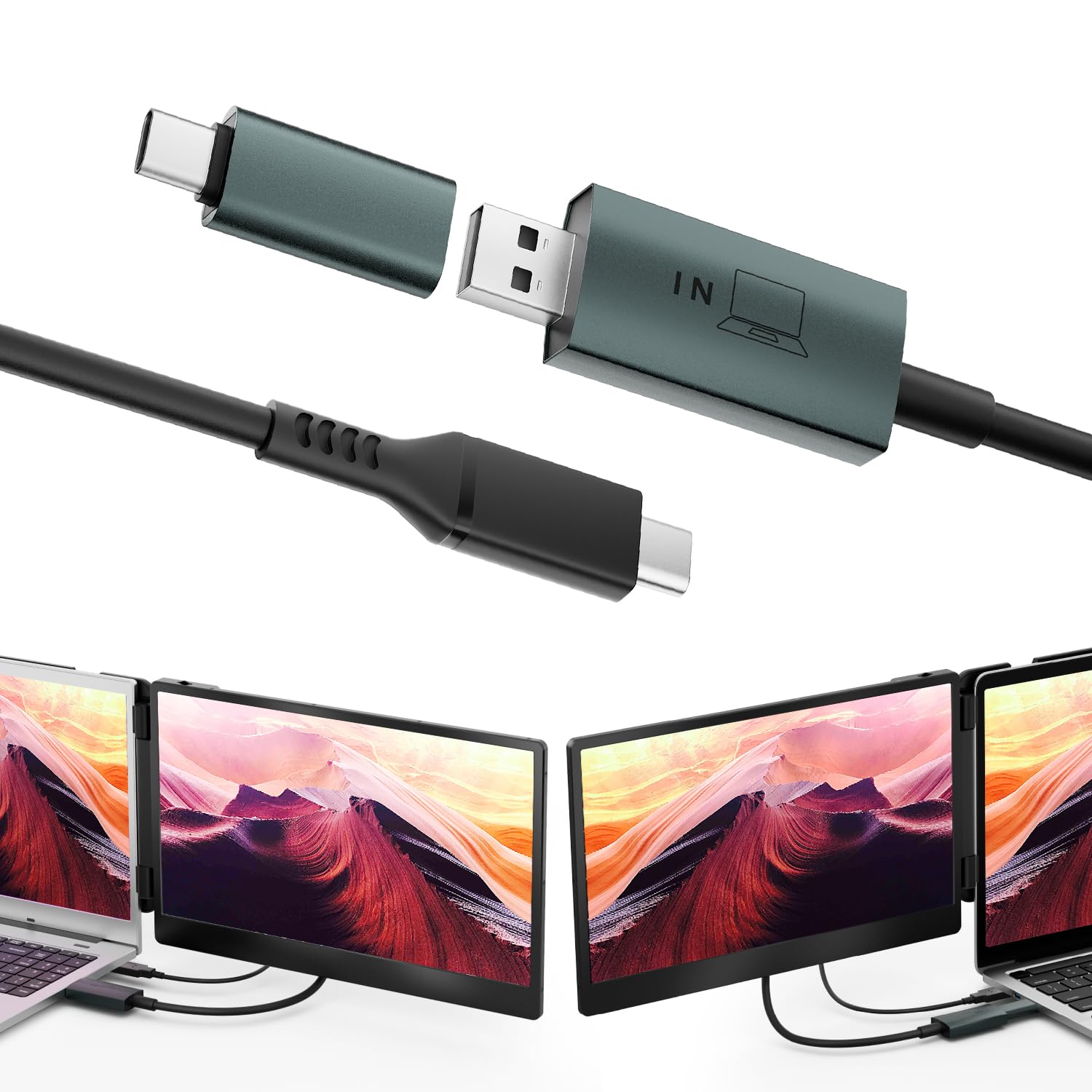
Will this let me run any monitor from my laptop's USB port?
No, and this is the thing to settle before anything else. Teamgee states plainly that the H5-T is only for its own S1, S2, S3 and S6 monitors, and that it connects to the Type-C port marked DP on the back of the screen. It is not a general-purpose USB-to-HDMI adapter for whatever display you already own. If you do not have one of those Teamgee screens, nothing else on this page matters much: it is the wrong part, and no amount of driver work will change that. Check the label on the back of your screen before ordering.
My laptop already has USB-C. How do I know whether I need this at all?
A USB-C port is not automatically a video port. Carrying a display signal needs DisplayPort Alt Mode, a hardware capability the manufacturer either built into that specific port or did not, and it cannot be switched on in software afterwards. Check your laptop maker's technical specifications for wording such as DisplayPort over USB-C, USB4 or Thunderbolt. A lightning bolt or DP marking beside the socket is a hint, not proof. This hub exists for machines whose ports move data only, which is exactly the gap owners bought it to close.
Why does it need a driver when a video cable normally just works?
Because no display signal is leaving the port in the first place. A plain USB connection carries data, not video, so a device like this works the other way round: software on your computer creates a virtual display, compresses each frame and streams it over USB for the hub to turn back into a picture. That is why Teamgee makes the driver mandatory rather than optional, and why this class of device behaves differently from a straight cable in ways worth knowing before you order rather than after.
Driver installation is the main complaint. How do I get through it cleanly?
Plan for it rather than trusting the pop-up to handle everything. Use an administrator account, let the installer finish completely and restart before judging the result. On recent macOS versions, software that builds a virtual display may need to be granted the Screen Recording privacy permission. Nothing is being recorded; it is simply how the system lets a driver read the pixels it needs. If everything appears connected but the screen stays blank, check that permission, then the power adapter and the monitor port.
Does the monitor still need its own power supply?
Yes. Teamgee specifies connecting an external 5V/2A adapter to power the screen while the hub is in use, so budget a spare socket and do not expect a single cable from the laptop to do everything. The reason is simple: the hub carries the picture, not power for the panel, and a laptop's USB port has only a limited amount of power to spare. Without the adapter the display is likely to stay dark or behave erratically, which reads as a fault but is not one.
Is the picture good enough for video or gaming?
Set expectations at productivity rather than motion. Because frames are compressed and pushed down a USB connection instead of travelling over a dedicated video link, this class of device suits documents, email, spreadsheets and reference windows far better than fast action, and owner feedback on performance here is mixed rather than glowing. If the second screen is where your code, your notes or your inbox live, it does that job. If it is where you want to play or watch, connect it directly instead.