

The Short Version
Expect to spend $25-$100 at the budget end and $250+ at the top. The specification that matters most is CADR Rating and Room Size Matching. Our pick across the range is the Air Purifiers for Home up to 2200 Ft² Large at $59.98.
What It Costs
-
Budget $25-$100
Budget purifiers handle small spaces (150-300 square feet) with genuine HEPA filtration but typically use less efficient AC motors, louder operation (45-55 dB on medium), and basic controls without air quality monitoring. Filter replacements cost $20-40 every 4-6 months. These units work adequately for single bedrooms, home offices, or dorm rooms where space is limited and noise tolerance is higher. Expect basic three-stage filtration (pre-filter, HEPA, minimal carbon) with manual speed controls. Build quality is acceptable but not exceptional—plastic housings, simpler fan assemblies, and shorter overall lifespans (3-5 years typical). Best for budget-conscious buyers with modest air quality needs or those testing whether air purification provides noticeable benefits before investing in premium units.
 We'd buy
Honeywell AllergenPlus HEPA Air Purifier
4.6 $32.79
We'd buy
Honeywell AllergenPlus HEPA Air Purifier
4.6 $32.79
-
Mid-range $100-$250
Mid-range purifiers offer the best value proposition, covering 300-600 square feet with proven HEPA filtration, quieter brushless motors (30-45 dB on medium), and useful features like air quality sensors, auto mode, and timer functions. Filter costs run $30-50 every 6-8 months. This category includes well-established brands with reliable customer support and readily available replacement filters. Expect more substantial activated carbon layers (1-2 pounds) for effective odor control, sturdier construction, and longer lifespans (5-7 years). Many include washable pre-filters reducing ongoing costs. These units handle most residential needs effectively—master bedrooms, living rooms, or open-concept spaces up to 500 square feet with proper air changes. The sweet spot for most buyers seeking proven performance without paying for premium brand names or marginal feature improvements.
 We'd buy
Medify MA-40 Air Purifier with True HEPA H13
4.6 $249.99
We'd buy
Medify MA-40 Air Purifier with True HEPA H13
4.6 $249.99
-
Premium $250+
Premium purifiers justify higher prices through superior engineering: exceptionally quiet operation (under 30 dB on low, under 40 dB on high), coverage for large spaces (600-1,500+ square feet), advanced sensors monitoring multiple pollutants (PM2.5, PM10, VOCs, humidity), smartphone connectivity, and medical-grade H13/H14 HEPA filtration. Build quality is noticeably superior with metal housings, precision-engineered fan systems, and expected lifespans exceeding 10 years. Some include washable HEPA filters (though effectiveness degrades over time) or long-life filters lasting 12-18 months. Energy efficiency is optimized, and noise engineering produces pleasant white noise rather than mechanical sounds. Best for large open-concept homes, severe allergy or asthma sufferers requiring maximum particle capture, or buyers prioritizing whisper-quiet operation and premium aesthetics. The performance gap over mid-range units is real but incremental—perhaps 15-20% better particle capture and 25-30% quieter operation, which matters tremendously to some buyers and not at all to others.
Nothing we have tested lands in this bracket yet.
What to Look For
The single most critical specification is Clean Air Delivery Rate (CADR), measured in cubic feet per minute (CFM). This EPA-recognized metric tells you how quickly a purifier can filter air, with separate ratings for smoke, dust, and pollen. For a 300-square-foot bedroom with standard 8-foot ceilings, you need a minimum CADR of 200 CFM to achieve five air changes per hour—the medical standard for meaningful air quality improvement. Yet many manufacturers bury or omit CADR ratings entirely, instead promoting vague room size claims that assume impossibly low air change rates. Always verify CADR numbers through AHAM (Association of Home Appliance Manufacturers) certification rather than trusting manufacturer claims alone.
True HEPA filtration remains the gold standard, but the terminology has become deliberately confusing. Genuine HEPA filters must capture 99.97% of particles at 0.3 microns—the most penetrating particle size. Terms like 'HEPA-type,' 'HEPA-style,' or 'HEPA-like' are marketing inventions with no standardized meaning and typically indicate filters that capture only 85-90% of particles. H13 and H14 ratings (medical-grade HEPA) actually exceed standard HEPA performance, capturing 99.95% and 99.995% respectively at the same particle size. For allergy and asthma management, pulmonologists consistently recommend true HEPA as the minimum acceptable standard, with H13 providing measurable additional benefits for severe respiratory conditions.
Noise levels directly impact whether you'll actually use the device consistently. Manufacturers typically advertise their lowest speed setting—often an ineffective 20-25 dB whisper—while omitting that effective purification requires medium or high speeds producing 50-60 dB, roughly equivalent to normal conversation volume. For bedroom use, look for units maintaining under 35 dB at their medium setting, which provides adequate air changes without disrupting sleep. The motor type matters significantly here: brushless DC motors run substantially quieter than traditional AC motors while consuming 40-50% less electricity.
Filter replacement costs represent the true long-term investment and vary dramatically between models. A $100 unit with $60 filters needed every four months costs $280 annually in maintenance, while a $300 unit with $40 filters lasting eight months costs just $60 yearly—a $220 annual difference that reverses the value equation within two years. Calculate the five-year total cost of ownership (purchase price plus filter replacements) rather than focusing solely on initial price. Also verify that replacement filters remain readily available; several brands have discontinued filter production for older models, rendering the units unusable.
Energy consumption adds another ongoing cost that manufacturers rarely highlight. Units running continuously (the recommended usage pattern) can consume 30-100 watts depending on speed settings. At $0.13 per kWh (the 2025 national average), a 50-watt unit costs approximately $57 annually in electricity, while a less efficient 100-watt model doubles that to $114. Look for Energy Star certification and check the wattage specifications across all fan speeds, not just the eco mode you'll rarely use.
The Features That Matter
-
01
CADR Rating and Room Size Matching
The CADR number determines actual purification capacity and must match your room dimensions. Calculate your room volume (length × width × height), then multiply by 5 to get the minimum CADR needed for effective filtration. A 400-square-foot room with 8-foot ceilings requires a CADR of at least 267 CFM. Manufacturers often claim coverage areas based on just 2 air changes per hour, which provides minimal health benefit. Verify AHAM certification rather than trusting marketing claims, as independent testing frequently reveals actual CADR rates 30-40% below advertised figures.
-
02
True HEPA vs HEPA-Type Filtration
Genuine HEPA filters meeting HEV (High Efficiency Particulate Air) standards capture 99.97% of 0.3-micron particles, the size most likely to penetrate lung tissue. HEPA-type, HEPA-like, and similar terms are unregulated marketing language indicating significantly lower performance, typically 85-90% capture rates. For allergy and asthma management, allergists specifically recommend true HEPA as the minimum standard. H13 medical-grade HEPA (99.95% capture) and H14 (99.995%) provide measurably better performance for severe respiratory conditions, wildfire smoke, and immune-compromised individuals, though at higher filter replacement costs.
-
03
Multi-Stage Filtration System
Effective air purifiers use three distinct layers: a pre-filter capturing large particles like pet hair and dust (extending HEPA filter life), the HEPA filter for fine particulates, and an activated carbon filter for odors and volatile organic compounds (VOCs). The carbon filter weight matters significantly—effective odor removal requires at least 1-2 pounds of activated carbon, while many budget units include token carbon layers weighing just a few ounces that provide negligible odor control. Pre-filters should be washable and reusable to reduce ongoing costs. Some units add UV-C or ionization stages, though medical evidence for their effectiveness remains limited and ionizers can produce harmful ozone as a byproduct.
-
04
Air Quality Monitoring and Auto Mode
Built-in particle sensors (measuring PM2.5 and PM10 levels) allow the unit to automatically adjust fan speed based on actual air quality, optimizing both performance and energy efficiency. Quality sensors update readings every 1-2 minutes and display numerical PM2.5 values, not just vague color indicators. This feature becomes particularly valuable during wildfire season or for monitoring cooking-related pollution. However, sensors require periodic cleaning (typically every 2-3 months) to maintain accuracy, and budget units often use unreliable sensors that trigger fan changes erratically. Manual control remains perfectly adequate if you're willing to adjust settings based on activities like cooking or vacuuming.
-
05
Filter Replacement Indicators and Availability
Timer-based filter indicators track usage hours and alert you when replacement is due, typically every 6-12 months depending on air quality and usage. More sophisticated sensors monitor actual filter resistance and airflow degradation for more accurate replacement timing. Verify that replacement filters are readily available from multiple retailers and check current pricing before purchasing—some manufacturers use a razor-and-blades model with affordable units but expensive proprietary filters. Generic compatible filters exist for popular models but may not meet the same filtration standards. Calculate the total five-year cost including all filter replacements to understand true ownership costs.
-
06
Noise Level Across All Speed Settings
Manufacturers advertise the lowest speed setting (typically 20-30 dB, barely audible) while omitting that effective purification requires medium or high speeds. For bedroom use, medium speed should produce no more than 35-40 dB for sleep compatibility—roughly equivalent to a quiet library. Check third-party reviews for actual noise measurements rather than trusting specifications. Brushless DC motors run significantly quieter than traditional AC motors while also reducing energy consumption by 40-50%. The fan design and airflow pattern also affect perceived noise; some units produce a gentle white noise that many find sleep-conducive, while others create annoying high-pitched whines.
Mistakes to Avoid
-
Selecting Based on Room Size Claims Alone
Manufacturers calculate room coverage using just 2 air changes per hour, far below the 4-5 changes medical professionals recommend for meaningful air quality improvement. A unit claiming 1,000-square-foot coverage may achieve only 400 square feet at effective purification rates. This explains why many buyers report disappointing results despite purchasing appropriately sized units according to marketing materials.
Calculate required CADR by multiplying your room volume by 5, then select a unit meeting or exceeding that number. For a 300-square-foot bedroom with 8-foot ceilings (2,400 cubic feet), you need a minimum CADR of 200 CFM. Verify AHAM-certified CADR ratings rather than trusting room size claims. When in doubt, size up—excess capacity allows quieter operation at lower fan speeds while maintaining effective air changes.
-
Ignoring Filter Replacement Costs and Availability
A $100 purifier seems economical until you discover that proprietary filters cost $60 every four months, totaling $180 annually—more than the unit's purchase price. Over five years, filter costs can exceed $900 while the unit itself cost just $100. Some manufacturers discontinue filter production for older models, rendering perfectly functional units useless. Several budget brands lack reliable filter availability, forcing buyers to purchase expensive expedited shipping or wait weeks for international shipments.
Before purchasing, research current filter prices from multiple retailers and verify availability. Calculate the five-year total cost of ownership: purchase price plus estimated filter replacements (typically 6-10 filters depending on lifespan). Compare this total across models—a $300 unit with $35 filters lasting 8 months costs $1,513 over five years, while a $150 unit with $50 filters every 4 months costs $1,650, making the pricier unit the better value. Check whether quality generic filters exist for popular models, potentially reducing costs further.
-
Falling for Ionizer and UV-C Marketing Claims
Manufacturers heavily promote ionization and UV-C sterilization as advanced technologies that eliminate viruses and bacteria, often charging premium prices for these features. However, independent testing shows minimal real-world effectiveness—UV-C requires extended exposure time to inactivate pathogens, which doesn't occur as air rapidly passes through the chamber. Ionizers can produce ozone as a byproduct, a lung irritant that the EPA warns against, particularly for people with asthma. The California Air Resources Board has established strict ozone emission limits that some ionizing purifiers exceed.
Prioritize proven HEPA filtration over supplementary technologies with questionable effectiveness. True HEPA filters physically capture viruses and bacteria with 99.97% efficiency without producing harmful byproducts. If considering a unit with ionization, verify it's certified ozone-safe by CARB (California Air Resources Board) and can be permanently disabled if you experience any respiratory irritation. UV-C may provide marginal additional benefit but shouldn't be a primary decision factor or justify significant price premiums over comparable HEPA-only units.
-
Running Purifiers Only When Rooms Are Occupied
Many buyers operate purifiers intermittently to save electricity or extend filter life, running them only when actively using a room. This approach fundamentally misunderstands how particulate pollution works—allergens, dust, and other particles continuously circulate and settle, requiring constant filtration to maintain clean air. Turning a purifier on after entering a room means you're breathing polluted air for 30-60 minutes while it works to clean the space. Pet dander, dust mites, and mold spores don't disappear when you leave a room; they require continuous removal.
Run purifiers continuously on appropriate speed settings for your air quality conditions. Modern energy-efficient units consume just 10-30 watts on low speeds, costing approximately $10-30 annually in electricity—a negligible expense for continuous air quality improvement. Use auto mode if available, allowing the unit to increase speed when sensors detect elevated particle levels, then return to quiet operation once air is clean. Position purifiers to run 24/7 in bedrooms where you spend 7-9 hours nightly, as this provides the greatest health benefit per dollar spent.
-
Placing Purifiers Against Walls or in Corners
Air purifiers require unobstructed airflow to function effectively, drawing air from all sides and expelling it through directional vents. Placing units against walls or in corners blocks intake vents, reducing airflow by 30-50% and dramatically decreasing effective CADR. Furniture, curtains, and other obstacles create dead zones where air doesn't circulate, leaving pockets of unpurified air. Many buyers position purifiers for aesthetic convenience rather than functional effectiveness, then wonder why air quality doesn't improve despite running the unit continuously.
Position purifiers at least 12-18 inches from walls and furniture, ideally in open areas where air circulates freely. For bedrooms, place units 3-5 feet from your bed at roughly head height when sleeping, ensuring you breathe the cleanest air. Avoid corners, behind furniture, or inside closets. If the unit has directional output, angle it toward the center of the room rather than walls. For open floor plans, position purifiers centrally rather than at room edges. Aesthetics matter, but a visible, properly positioned purifier that works effectively beats an attractively hidden unit that underperforms by 40%.
Our Picks
-
Runner-up
Air Purifier for Home
H13 True HEPA filter captures 99.97% of particles down to 0.3 microns, a true HEPA grade rather than a HEPA-type filter
$35.98 4.2
Check price on Amazon -
Best overall
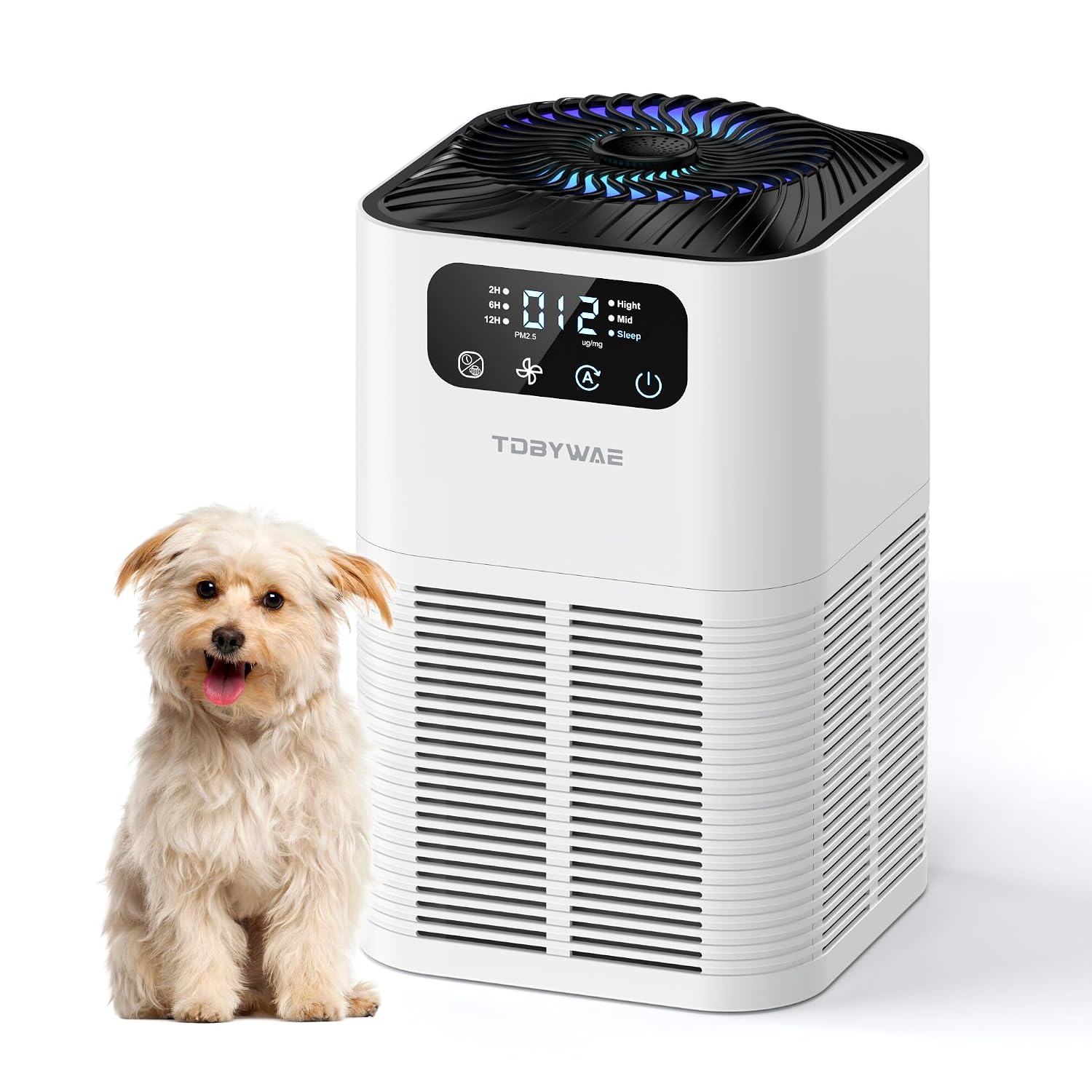
Air Purifiers for Home up to 2200 Ft² Large
Three-stage filtration: a pre-filter for pet hair, a true H13 HEPA stage rated to block 99.99 percent of dust, pollen and allergens, and an activated carbon layer for odors and VOCs
$59.98 4.4
Check price on Amazon -
Specialty pick
BLUEAIR Air Purifier Large Room
AHAM Verifide CADR of 350 for smoke, pollen and dust particles
$69.99 4.7
Check price on Amazon

Looking After It
Air purifier maintenance directly impacts both performance and longevity, yet many owners neglect simple tasks that would extend filter life and maintain optimal air cleaning. The pre-filter requires vacuuming or washing every 2-4 weeks depending on your environment—homes with pets, high dust, or nearby construction need more frequent cleaning. Remove the pre-filter and either vacuum both sides thoroughly or rinse washable filters under cool water, allowing 24 hours to dry completely before reinstalling. This single habit can extend HEPA filter life by 30-40% by preventing large particles from prematurely clogging the primary filter. Never wash or wet the HEPA filter itself, as moisture destroys the filtration media and can promote mold growth.
The air quality sensor requires cleaning every 2-3 months to maintain accuracy. Dust accumulation on the sensor lens causes false readings, triggering unnecessary fan speed increases that waste energy and create noise. Most units provide sensor access through a small panel; gently wipe the sensor with a dry cotton swab or soft brush, avoiding any liquids or compressed air that might damage sensitive components. The exterior housing benefits from weekly dusting or wiping with a slightly damp cloth, preventing dust buildup that can be drawn into the intake vents. Check the area around the purifier monthly, ensuring furniture, curtains, or stored items haven't encroached on the recommended clearance space.
Filter replacement timing depends on your specific air quality conditions rather than arbitrary schedules. Most manufacturers recommend replacement every 6-12 months, but homes with pets, smokers, or high pollution may need changes every 4-6 months, while clean environments might extend filters to 12-15 months. Monitor the filter replacement indicator, but also inspect filters visually every few months—HEPA filters should appear uniformly gray (not black or heavily discolored), and carbon filters shouldn't smell musty. When airflow noticeably decreases even on high settings or the unit struggles to reduce particle counts shown on the display, replacement is overdue. Always purchase filters before you need them, as waiting for shipping while running a clogged filter reduces effectiveness by 50% or more and strains the motor, potentially shortening the unit's lifespan. Store spare filters in their sealed packaging in a cool, dry location away from strong odors that the carbon layer might absorb.
Common Questions
Do air purifiers actually work, or is this just marketing hype?
Air purifiers with true HEPA filtration demonstrably reduce airborne particulates, with numerous peer-reviewed studies confirming 50-80% reductions in indoor particle concentrations when properly sized and operated. The American Academy of Allergy, Asthma, and Immunology recognizes HEPA filtration as an effective environmental control measure for allergic rhinitis and asthma management. However, effectiveness depends entirely on proper implementation—a purifier must have adequate CADR for your room size, run continuously rather than intermittently, and use genuine HEPA filtration rather than inferior alternatives. The hype enters when manufacturers make unsupported claims about virus elimination, health transformations, or miracle technologies beyond proven HEPA filtration. An appropriately sized, properly maintained HEPA purifier will measurably improve your indoor air quality; it won't cure diseases, eliminate all allergens, or compensate for poor ventilation and other environmental factors.
How do I calculate what size air purifier I actually need for my room?
Calculate your room's volume by multiplying length × width × ceiling height in feet, then multiply that number by 5 to determine the minimum CADR (Clean Air Delivery Rate) required for effective purification with five air changes per hour. For example, a 15-foot by 20-foot bedroom with 8-foot ceilings contains 2,400 cubic feet, requiring a CADR of at least 200 CFM (2,400 ÷ 60 minutes × 5 air changes). Ignore manufacturer room size claims, which typically assume just 2 air changes per hour—inadequate for meaningful air quality improvement. Verify the AHAM-certified CADR rating specifically for smoke particles (the smallest and most challenging to filter) rather than the often-higher dust or pollen ratings. When between sizes, choose the larger capacity unit, which allows quieter operation at lower fan speeds while still achieving proper air changes. For open-concept spaces, calculate the total volume of connected areas, or use multiple smaller units rather than expecting one purifier to handle spaces beyond its CADR capacity.
Are expensive air purifiers worth it compared to budget models?
The price-to-performance relationship is non-linear—mid-range units ($100-250) often deliver 85-90% of the air cleaning performance of premium models at half the cost, making them the best value for most buyers. Premium units justify higher prices through quieter operation (often 10-15 dB lower on comparable settings), more sophisticated sensors and controls, better build quality with longer lifespans, and sometimes superior filtration with H13/H14 medical-grade HEPA. However, a properly sized $150 unit with true HEPA filtration will clean your air nearly as effectively as a $400 model in the same room. The performance gap matters most for specific use cases: severe allergies or asthma benefiting from H13/H14 filtration, bedrooms where whisper-quiet operation is essential, or large open spaces requiring high CADR ratings found only in premium units. Calculate total five-year ownership costs including filter replacements—some expensive units have cheaper, longer-lasting filters that offset the higher purchase price, while some budget units have costly filters that reverse the value equation within two years. For most residential applications, a quality mid-range unit provides the optimal balance of performance, features, and cost.
Can air purifiers help with wildfire smoke and cooking odors?
HEPA filters excel at capturing the fine particulate matter (PM2.5) in wildfire smoke, which poses the greatest health risk. Studies during California wildfires showed properly sized HEPA purifiers reduced indoor PM2.5 levels by 60-85% even when outdoor air quality reached hazardous levels. However, smoke odor removal requires substantial activated carbon filtration—at least 1-2 pounds of activated carbon to effectively adsorb volatile organic compounds and odor molecules. Many air purifiers include token carbon layers weighing just a few ounces that capture particles but do little for odors, explaining why some users report cleaner air that still smells smoky. For cooking odors, carbon filtration helps but cannot match the effectiveness of proper kitchen ventilation—range hoods vented outdoors remove odors at the source before they spread. Air purifiers work best as supplementary odor control, handling what ventilation misses or managing odors in spaces without direct ventilation. Replace carbon filters more frequently (every 3-6 months) if odor control is your primary concern, as activated carbon saturates faster than HEPA filters clog, losing effectiveness while the HEPA layer continues working normally.
Should I run my air purifier all the time or only when I am in the room?
Continuous operation provides dramatically better air quality than intermittent use. Airborne particles, allergens, and pollutants circulate constantly—dust settles and re-suspends, pet dander accumulates, outdoor pollution infiltrates through windows and doors, and activities like walking or making beds stir settled particles back into the air. Running a purifier only when occupying a room means you breathe polluted air for 30-60 minutes while the unit works to clean the space, then the air quality degrades again when you turn it off. Continuous operation maintains consistently clean air, providing immediate benefits when you enter the room. Modern energy-efficient purifiers consume just 10-30 watts on low speeds, costing $10-30 annually in electricity—negligible compared to the health benefits. Use auto mode if available, allowing the unit to increase speed when sensors detect elevated particles, then return to quiet operation. For bedrooms where you spend one-third of your life, continuous operation is particularly important, as nighttime is when your body repairs and regenerates, processes best supported by clean air. The filter lifespan argument against continuous operation is false economy—filters cost $30-60 and last 6-12 months with continuous use, a worthwhile investment for constant air quality improvement.
What is the difference between HEPA, H13, and HEPA-type filters?
True HEPA filters meeting the U.S. Department of Energy standard capture 99.97% of particles at 0.3 microns—the most penetrating particle size that's hardest to filter. This is a legally defined specification requiring independent testing and certification. H13 and H14 are European classifications (ISO 29463) that actually exceed HEPA standards: H13 captures 99.95% of 0.3-micron particles, while H14 captures 99.995%, providing measurably better filtration for medical environments, severe allergies, or immune-compromised individuals. The performance difference between HEPA and H13 is relatively small for most users but matters for those with serious respiratory conditions. HEPA-type, HEPA-like, HEPA-style, and similar terms are unregulated marketing language with no standardized meaning—manufacturers use these phrases to suggest HEPA-level performance while delivering significantly inferior filtration, typically 85-90% capture rates. These filters cost less to manufacture and allow higher airflow (enabling inflated room size claims), but provide substantially less health benefit. Always verify 'True HEPA' or 'H13/H14' specifications from reputable brands rather than accepting vague HEPA-adjacent terminology. For allergy and asthma management, allergists specifically recommend true HEPA as the minimum acceptable standard, with H13 providing additional benefits worth the modest cost increase for severe conditions.
In Short
Selecting an effective air purifier requires cutting through aggressive marketing to focus on verified specifications and proven technologies. The fundamentals remain straightforward: match AHAM-certified CADR ratings to your actual room volume (not manufacturer room size claims), insist on true HEPA filtration rather than inferior alternatives, and calculate total five-year ownership costs including filter replacements rather than fixating on purchase price alone. Mid-range units from established manufacturers typically deliver the best value, providing 85-90% of premium performance at half the cost while avoiding the quality compromises and reliability issues common in budget models.
The most sophisticated purifier available cannot compensate for fundamental mistakes like inadequate capacity for your space, intermittent operation, or poor positioning that blocks airflow. Success requires both appropriate equipment and proper implementation—continuous operation, regular maintenance, and realistic expectations about what air purification can and cannot achieve. For most buyers, a properly sized unit with proven HEPA filtration, reasonable noise levels, and affordable filter replacements will deliver meaningful air quality improvements and genuine health benefits, provided you commit to running it consistently rather than treating it as an occasional-use appliance.